WAFF 48 First Alert Weather
- 4.6
- Rating
- 100.00K
- Installs
- Free
- Price
 Analysis by App-foxy
I usually judge a weather app by what happens after the first few days. The opening impression matters, but the real question is whether I still reach for it when I am rushing out the door, planning a drive, or deciding whether outdoor plans need a backup. WAFF 48 First Alert Weather makes a sensible case for that kind of routine use. It is a free weather app from Gray Media, built around the WAFF 48 weather service, and its main appeal is straightforward: it gives weather information a local-news feel without asking me to pay before I can make it part of my daily routine.
That simplicity is important. Weather apps are easy to download and just as easy to abandon when they become noisy, confusing, or redundant with the phone’s built-in forecast. My experience with this one is that its value depends less on novelty and more on whether I want a dedicated local weather destination. If I only need a quick temperature glance, the default phone app may be enough. If I prefer a weather-focused app connected to a familiar regional news brand, this is a more convincing option.
What the first week feels like
The first week is when the app has to earn permission to become a habit. I would start by checking the current conditions, then comparing the forecast with what I actually see outside. That small test is more useful than simply admiring a polished forecast screen. I want to know whether the information is easy to interpret before work, whether the outlook helps me plan errands, and whether the app makes changing plans less stressful.
You May Also Like

 Blood Strike: 2.5 Anniversary
Blood Strike’s Loadouts Turn Every Drop Into a Tactical Gamble
A close look at Blood Strike’s custom loadouts: how fast access to signature weapons reshapes its battle royale rhythm, rewards preparation, and narrows the gap between fights.

 Pandora - Music & Podcasts
Pandora’s Music Is Easy to Start, but Harder to Recover
Pandora’s strength is its low-effort path from a seed to a station. Its weak spot is how much confidence it asks you to place in connection, setup, and quiet recovery.

 8 Ball Pool
 Is Built on Rivalries, Rematches, and Routine
A close look at the rivalries, rematches, shared routines, and unanswered safety questions that turn a quick pool match into a persistent mobile community.

 Samsung Music
’s Quiet Strength Is Playing What You Already Own
Its reach comes less from spectacle than from dependable access to a personal library. That simplicity is both the app’s strongest retention engine and its ceiling.

 AccuWeather: Weather Radar
AccuWeather Review: A Quick, Clear Forecast for Everyday Decisions
For everyday plans, the best forecast is the one you can understand quickly. AccuWeather makes rain timing, radar, and local conditions easy to act on, with a few trade-offs.

 Hill Climb Racing
Why Hill Climb Racing Still Turns Crashes Into One More Run
A tiny car, a bumpy hill and one more upgrade: Hill Climb Racing keeps resurfacing because its simple chaos makes every near-miss feel personal.
More From Our News Desk



WAFF 48 First Alert Weather is positioned as a full-featured weather app rather than a simple temperature display. That distinction matters because a useful weather tool needs to support more than one glance. A morning check may be about clothing, while an afternoon check may involve a commute, a school pickup, or an outdoor appointment. I found the app most useful when I treated it as a planning tool instead of opening it only to see whether the day was warm.
The local-news connection also shapes the first impression. The developer, Gray Media, gives the app a recognizable regional identity through WAFF 48. For someone who already follows that outlet, the app can feel more familiar than a large international weather service. That familiarity is not automatically a guarantee that every forecast will be perfect, but it can make the information easier to trust and easier to remember as part of a daily routine.
One practical test is to check the forecast at the same moments each day for a week: before leaving home, around midday, and before making evening plans. This reveals whether the app fits naturally into your schedule. I would not rely on a single forecast glance to judge it. Weather changes, and the better question is whether the app helps me notice meaningful changes without forcing me to interpret a wall of information.
The strongest first-week benefit is decision support, not decoration. A weather app earns its place when it helps answer ordinary questions quickly: Do I need a jacket? Should I move an outdoor task earlier? Is a drive likely to be uncomfortable? WAFF 48 First Alert Weather is most appealing to people who want those answers in a dedicated local weather setting rather than through a general search or a bare system widget.
Who gets the quickest benefit
This app makes the most sense for residents who regularly plan around local conditions and prefer a regional source. It can also suit families, commuters, outdoor workers, and anyone who checks conditions several times during a changing day. The free price lowers the barrier to trying it, while an Everyone content rating makes it suitable for a broad household audience.
The benefit is less obvious for someone who travels constantly across regions or countries. A local-news weather app can be comfortable for home routines, but frequent travelers often need a service designed around many locations, broader map coverage, or more specialized travel planning. I would also hesitate to make it my only tool for high-stakes outdoor decisions. A forecast app can inform a choice, but it should not replace official emergency guidance when conditions become dangerous.
Another realistic use case is a parent preparing for a busy weekday. I might check the morning outlook before choosing what the children wear, look again before the school run, and make a final decision about an evening practice later in the day. The value is not that the app eliminates uncertainty; it is that repeated checks are easier when the weather information is already in one familiar place.
Why it can remain useful month after month
After the novelty fades, a weather app survives on repetition. There is no collection system, social feed, or entertainment loop here to pull me back. That is actually a strength for some people. I do not need to manage another content stream. I need a dependable place to check conditions when the weather affects a decision.
The app’s long-term value comes from low-effort repetition. If I open it before commuting, before exercising outside, or before arranging weekend plans, it becomes part of the same mental checklist as checking a calendar. The best weather tools do not demand attention; they quietly reduce the number of small decisions I have to make.
Its rating of 4.6 from around seven thousand ratings suggests that many users find the overall experience worthwhile, while roughly one hundred thousand or more installs show that it has reached a meaningful audience. Those figures do not tell me that every user will agree with every forecast or interface choice, but they do indicate that this is an established app rather than an untested experiment.
I also like that its usefulness does not depend on a rare event. Severe weather may make a weather app feel essential for a short period, but lasting value comes from ordinary days. Checking rain before a bike ride, judging whether a coat is needed, or deciding when to wash the car may sound minor, yet those repeated moments are exactly what can justify keeping a weather app installed.
There is a useful habit I would recommend: do not check only the current condition. Look at the forecast in relation to the specific time of your activity. A pleasant morning can hide an uncomfortable afternoon, and a dry start can create false confidence about an evening plan. The app becomes more valuable when I use it to compare the timing of weather with the timing of my commitments.
Maintenance without turning weather into work
Maintenance is usually light for this kind of app, but light does not mean nonexistent. I would keep the app updated through the normal app-store process so that the current release remains compatible with the phone. The current version is 6.2.512, and the listed minimum operating-system requirement is version 9. That makes the app accessible to many older devices, although anyone using an especially old phone should still pay attention to compatibility during installation or updates.
The bigger maintenance task is personal: deciding whether the app still earns a place on the home screen. I would remove it from a prominent position if I kept opening it out of habit but never used the information. A weather app should save time, not create another routine that feels obligatory. Placing it near other practical tools can help, but there is no reason to keep it visually prominent if the phone’s built-in forecast already covers your needs.
I would also review the app’s notification behavior and location choices during setup and later use. Weather tools can become irritating when alerts arrive at inconvenient times or when the app is configured more broadly than necessary. The right balance is personal: someone who wants timely local warnings may accept more interruptions, while someone who checks manually may prefer a quieter experience. I would adjust those choices rather than judging the entire app by its default behavior.
One overlooked maintenance tip is to verify the selected location after traveling. A weather app can be useful at home and confusing when I return from a trip if it remains focused on a temporary place. Before making an important decision, I would confirm that the forecast is for the location I actually care about. This is a small check, but it prevents a surprisingly basic mistake.
Where fatigue can begin
The main source of fatigue is redundancy. Most modern phones already include a weather widget or a basic weather application. If that built-in option gives me the forecast I need in fewer taps, WAFF 48 First Alert Weather has to justify the extra space through its local identity and fuller weather experience. For some users, that will be enough. For others, installing a second weather app may feel unnecessary after the initial curiosity disappears.
Another possible friction point is information density. A full-featured weather app can be more useful than a simple widget, but it can also ask me to process more screens, labels, and forecast details. When I am standing outside deciding whether to leave, I do not want to study the interface. I prefer to use the app for a quick overview first, then explore more detail only when the decision actually requires it.
Forecast uncertainty can also create disappointment. No weather app controls the atmosphere, and a forecast that changes during the day is not automatically a sign that the app is broken. Still, repeated differences between what I expect and what happens outside can weaken trust. My approach is to use the app for planning with some flexibility, especially when the activity is several days away, rather than treating every forecast as a promise.
People who want highly specialized information may eventually outgrow it. A dedicated aviation, marine, mountain, or professional forecasting service can be a better choice when conditions have technical consequences. Likewise, someone who needs a single global dashboard for many cities may prefer an app designed specifically for travel. WAFF 48 First Alert Weather is better understood as an everyday local companion than as a specialist forecasting workstation.
There is also a difference between alerts that are useful and alerts that become background noise. If every notification feels urgent, I stop paying attention. I would keep only the alerts that match my real needs and rely on manual checks for routine planning. That approach preserves the app’s usefulness without allowing weather updates to dominate the day.
How it compares with the usual alternatives
Compared with a phone’s default weather widget, this app offers a more deliberate weather destination. The widget wins for speed: it is usually visible immediately and may be all I need for a quick temperature check. WAFF 48 First Alert Weather wins when I want to spend a little more time understanding the day or when the connection to a local news brand matters to me.
Compared with a broad national or international weather service, the appeal is different. Large services often make sense for users who move between many locations or want a single familiar interface everywhere. WAFF 48 First Alert Weather feels more appropriate when my life is centered in the WAFF 48 viewing area and I value a regional source. The trade-off is specialization: local relevance can be more comfortable at home, while a global service may be more flexible on the road.
Compared with searching the web for weather, the app is more convenient for repeated checks. A search can answer a one-time question, but opening a dedicated app is less disruptive when weather affects several decisions in the same day. The advantage is strongest when I already know I will return to the forecast; for a one-off question in an unfamiliar place, a web search may be faster.
Its free availability is another practical advantage. I can try it without turning the decision into a purchase, which makes comparison easy: install it, use it alongside the phone’s default option, and see which one I actually open. I would give the test enough time to include ordinary weekdays and a changing forecast rather than deciding after a single sunny morning.
Questions I would settle before keeping it
If I were wondering whether it is suitable for a family phone, the answer is generally yes from an age-rating perspective: it is rated Everyone. The more important question is whether every family member prefers a local-news weather experience. Children may only need a simple glance, while adults planning commutes or outdoor activities may appreciate a fuller view.
If I were concerned about an older device, I would check the operating-system requirement first. The app supports devices running version 9 or later, so compatibility is not limited to the newest phones. Even so, an older device may make any weather app feel slower or less comfortable, and that is a hardware consideration rather than a reason to expect identical performance on every phone.
If I were asking whether I should replace my current weather app, I would not switch automatically. I would compare the two during a week with varied plans and note which one helps me decide faster. The local connection is the strongest reason to move; if that does not matter to me, the built-in option may remain the more efficient choice.
If I were asking whether it is enough for emergencies, I would treat it as one source of information, not the only source. For serious weather, I would pay attention to official warnings and local emergency instructions as well. The app can help me notice changing conditions and plan around them, but responsible preparation requires more than any single forecast screen.
My long-term verdict
WAFF 48 First Alert Weather earns lasting space when I want a dependable, local-focused weather routine rather than another novelty download. Its free access, broad age rating, established presence, and strong average rating make it easy to try, while Gray Media’s connection to WAFF 48 gives it a clearer identity than an anonymous forecast utility.
I would keep it installed for regular local planning, especially if I already follow WAFF 48 and want weather information in the same regional context. I would not keep it merely because it is full-featured. If the default phone widget answers my questions faster, or if I spend most of my time traveling, another option may be a better fit.
My recommendation is to test it through real routines instead of judging it by the first opening. Check it before leaving home, revisit it when plans depend on the afternoon, and adjust its notifications so they remain useful. If those small interactions reduce uncertainty without adding friction, it has earned its place. If I keep opening it only to see the same information already visible elsewhere, the novelty has ended and the app should make room for a tool I use more often.
In the end, this is a practical weather app with recurring value for the right audience. It works best as a calm daily planning tool, not as a replacement for every specialized weather source. For local users who want that balance, I would recommend giving it a fair trial and keeping it only if its regional focus genuinely improves the way they plan their day.
FAQs for WAFF 48 First Alert Weather
01What is WAFF 48 First Alert Weather?
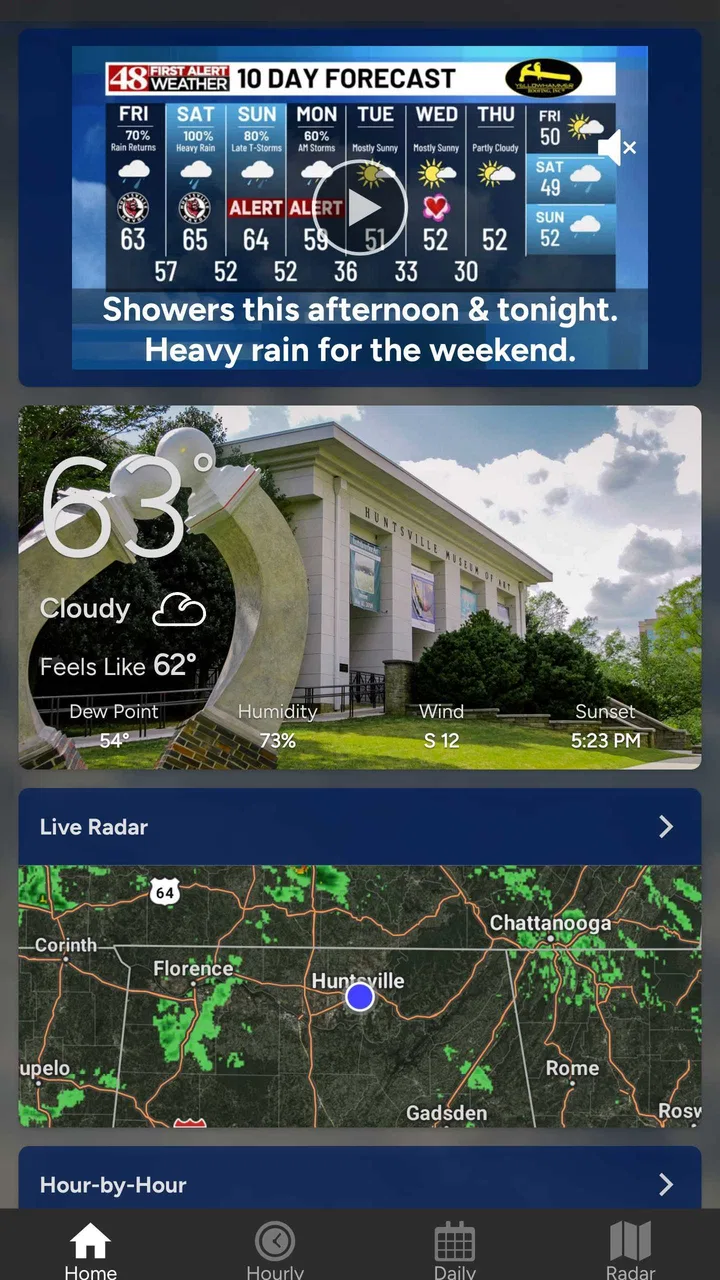
WAFF 48 First Alert Weather is a local weather app designed for viewers in the WAFF 48 coverage area, particularly North Alabama and southern Tennessee. It provides current conditions, hourly and extended forecasts, radar imagery, weather alerts, and updates from the station’s meteorologists. The app is intended to help users plan daily activities and stay informed during severe weather events.
02Does WAFF 48 First Alert Weather provide severe weather alerts?
Yes. The app can send notifications about important weather conditions, including severe thunderstorms, tornado warnings, flash flooding, winter weather, and other hazards affecting selected locations. Before relying on it, users should enable notifications and location permissions, then review their alert settings. For life-threatening emergencies, the app should complement—not replace—official emergency instructions and local authorities.
03Can I use the app to view weather radar and track storms?
WAFF 48 First Alert Weather includes radar and storm-tracking features that help users follow precipitation and developing weather systems. Depending on the version and available data, radar may include map layers, motion imagery, lightning information, and location-based viewing. Radar is especially useful during severe weather, although users should remember that brief delays and coverage limitations can occur.
04Does WAFF 48 First Alert Weather use my location?
The application can use your device location to show local conditions, forecasts, radar information, and relevant alerts for where you are. You may usually choose whether to allow location access all the time, only while using the app, or not at all, depending on your device settings. Without location permission, you can generally search for and save locations manually.
05Is WAFF 48 First Alert Weather free to download and use?
WAFF 48 First Alert Weather is generally available as a free download for compatible Android and iOS devices. The main weather tools, forecasts, radar, and alert features are typically accessible without a subscription, although the app may contain advertising or links to station content. Availability, supported features, and data usage can vary by device, region, and future updates.
Pros
- Accurate local forecasts for the greater Cincinnati and Tri-State area.
- First Alert notifications provide timely warnings for severe weather.
- Live radar helps track storms with clear map animations.
- Hourly and extended forecasts are easy to check at a glance.
- Video updates offer useful explanations from local meteorologists.
Cons
- Some features may require location access to work properly.
- Radar animations can feel slow on older or less powerful devices.
- Frequent alerts may become distracting during active weather events.
- Forecast details are less useful for users outside the station’s coverage area.
- Some content may depend on a stable internet connection.

WAFF 48 First Alert Weather
Gallery